9604095112

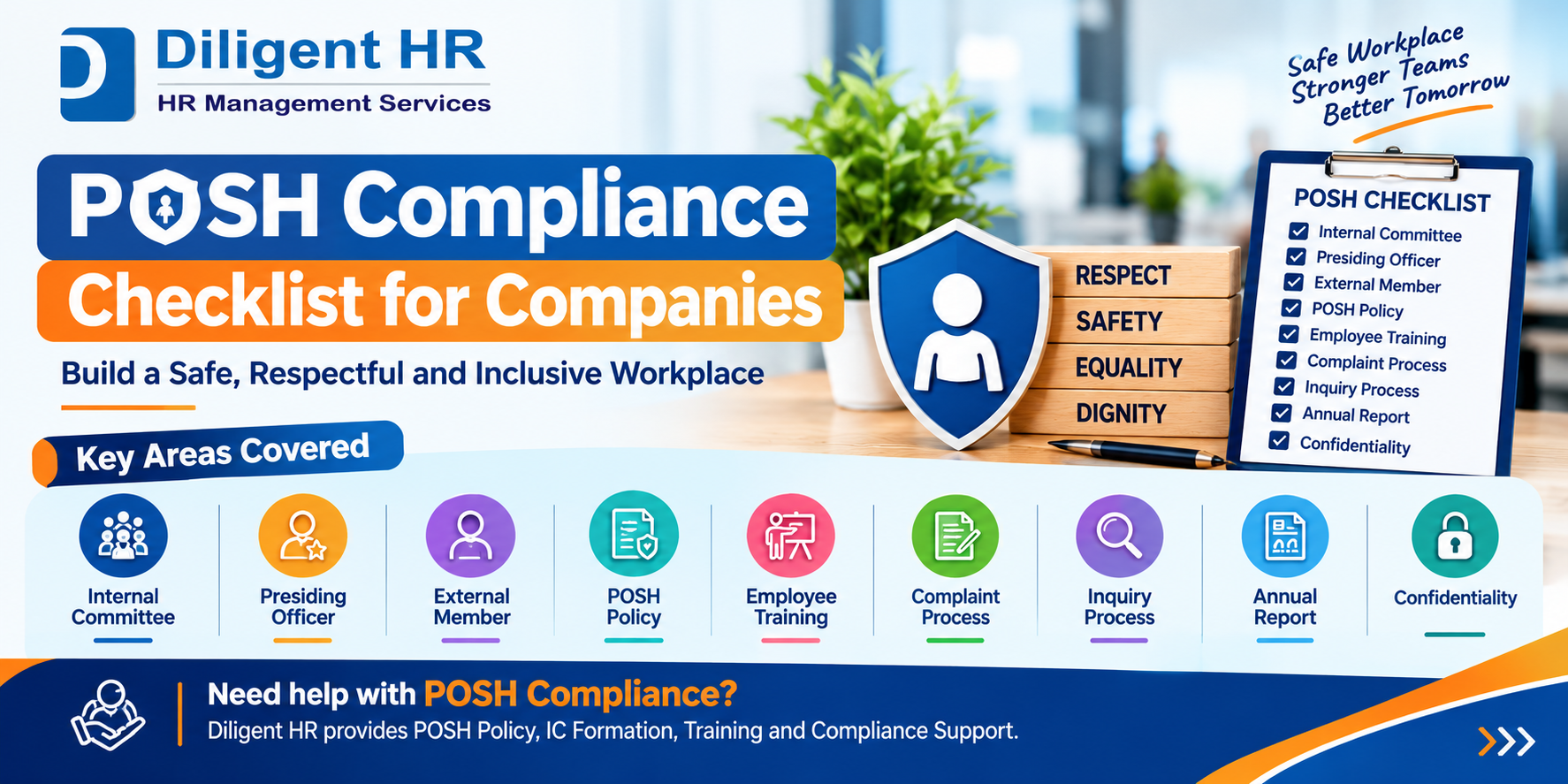

Creating a safe, respectful and inclusive workplace is an important responsibility of every employer. The Prevention of Sexual Harassment (POSH) Act, 2013 provides a framework for the prevention and redressal of sexual harassment at the workplace.
POSH compliance is not limited to creating an Internal Committee (IC). Employers should also establish appropriate policies, conduct employee awareness programmes, follow a fair complaint and inquiry process and maintain confidentiality.
For companies, startups and HR professionals, having a proper POSH compliance system can help create a professional workplace and ensure that complaints are handled through an appropriate process.
This practical POSH Compliance Checklist will help employers understand the important areas that should be reviewed as part of workplace POSH compliance.
POSH refers to the Prevention of Sexual Harassment of Women at Workplace framework under the Sexual Harassment of Women at Workplace (Prevention, Prohibition and Redressal) Act, 2013.
The objective of POSH compliance is to:
POSH compliance should be treated as an ongoing workplace responsibility rather than only a documentation requirement.
One of the important requirements under POSH compliance is the constitution of an Internal Committee where applicable.
The employer should ensure that:
A properly constituted and functioning Internal Committee is an important part of an effective POSH framework.
The Internal Committee should have a Presiding Officer as required under the applicable provisions of the POSH Act.
The Presiding Officer plays an important role in the functioning of the Internal Committee.
Responsibilities may include:
The company should ensure that the Presiding Officer is appointed in accordance with applicable legal requirements.
The Internal Committee should also include an External Member as required under the POSH Act.
The External Member can provide an independent perspective and relevant expertise during the POSH process.
The External Member should meet the applicable eligibility requirements and may have experience or knowledge relating to:
Companies should maintain appropriate documentation relating to the appointment of the External Member.
Every organization should have a clear and properly drafted POSH Policy.
The policy should help employees understand:
The POSH Policy should be communicated to employees and made accessible through appropriate company channels.
A clear policy provides employees with better understanding of their rights, responsibilities and the complaint mechanism.
Creating a POSH Policy alone is not sufficient. Employees should also be made aware of workplace POSH requirements.
Companies should conduct appropriate POSH awareness programmes and training sessions for employees.
POSH awareness sessions may cover:
Regular awareness programmes can help employees understand acceptable workplace behaviour and available reporting mechanisms.
Internal Committee members should receive appropriate training to understand their responsibilities.
Handling a POSH complaint requires sensitivity, confidentiality and an understanding of the applicable procedure.
IC Member training may cover:
Proper training can help Internal Committee members handle complaints professionally and in accordance with the applicable legal framework.
Employees should know how and where they can submit a complaint.
The organization should establish a clear complaint mechanism.
The process should provide clarity regarding:
Complaints should be handled sensitively and according to the applicable provisions of the POSH Act.
Companies should avoid informal handling of complaints without following the appropriate process.
Where applicable, conciliation may be considered in accordance with the provisions of the POSH Act.
Conciliation can only be initiated in the circumstances permitted by law and at the request of the aggrieved woman.
Important points include:
If conciliation is not requested or does not result in settlement, the matter may proceed according to the applicable inquiry process.
The inquiry process is one of the most important parts of POSH compliance.
The Internal Committee should ensure that the parties receive a fair opportunity to present their case, subject to the applicable legal framework.
A proper inquiry process may include:
The inquiry should follow principles of natural justice and procedural fairness.
During an inquiry, appropriate interim measures may be considered where permitted under the applicable provisions.
Depending on the circumstances, such measures may be recommended to provide appropriate protection and support during the inquiry process.
Any interim measure should be handled carefully and in accordance with applicable legal requirements.
Confidentiality is a critical part of the POSH process.
Information relating to a complaint should be handled carefully and should not be disclosed except as permitted or required under applicable law.
Companies and Internal Committee members should maintain confidentiality regarding information such as:
Maintaining confidentiality helps protect the dignity and privacy of everyone involved in the process.
Companies should maintain appropriate POSH compliance records.
Depending on the organization's requirements, records may include:
Proper documentation can help organizations demonstrate that appropriate POSH processes are in place.
The Internal Committee is required to prepare an annual report containing prescribed information.
The annual report may include information relating to:
Employers should ensure that applicable annual reporting and submission requirements are followed.
Companies should also maintain a compliance calendar to avoid missing important POSH-related reporting obligations.
Employers should communicate important POSH information through appropriate workplace channels.
This may include:
The objective should be to ensure that employees know where to seek help and how to report concerns.
Use the following checklist to review your organization's POSH compliance:
POSH compliance helps organizations create a professional, safe and respectful workplace.
Effective POSH compliance can support:
POSH compliance should not be treated as only a documentation exercise. The objective is to create a workplace where employees feel safe, respected and heard.
Some organizations focus only on creating an Internal Committee but overlook other important requirements.
Common mistakes include:
Regular POSH compliance reviews can help companies identify and address such gaps.
Managing POSH compliance requires appropriate policies, documentation, training and process implementation.
Diligent HR – HR Management Services provides professional support to companies, startups and organizations for their HR and workplace compliance requirements.
Is your company prepared for POSH compliance?
Diligent HR provides professional POSH Compliance Support to help organizations establish effective workplace policies and processes.
POSH compliance is not only about meeting statutory requirements. It is about building a workplace culture based on respect, dignity, fairness and safety.
Diligent HR – HR Management Services
Your Compliance. Our Commitment.
For professional HR, Payroll, Labour Law and POSH Compliance Support, connect with Diligent HR.
Website: www.diligenthr.com