9604095112

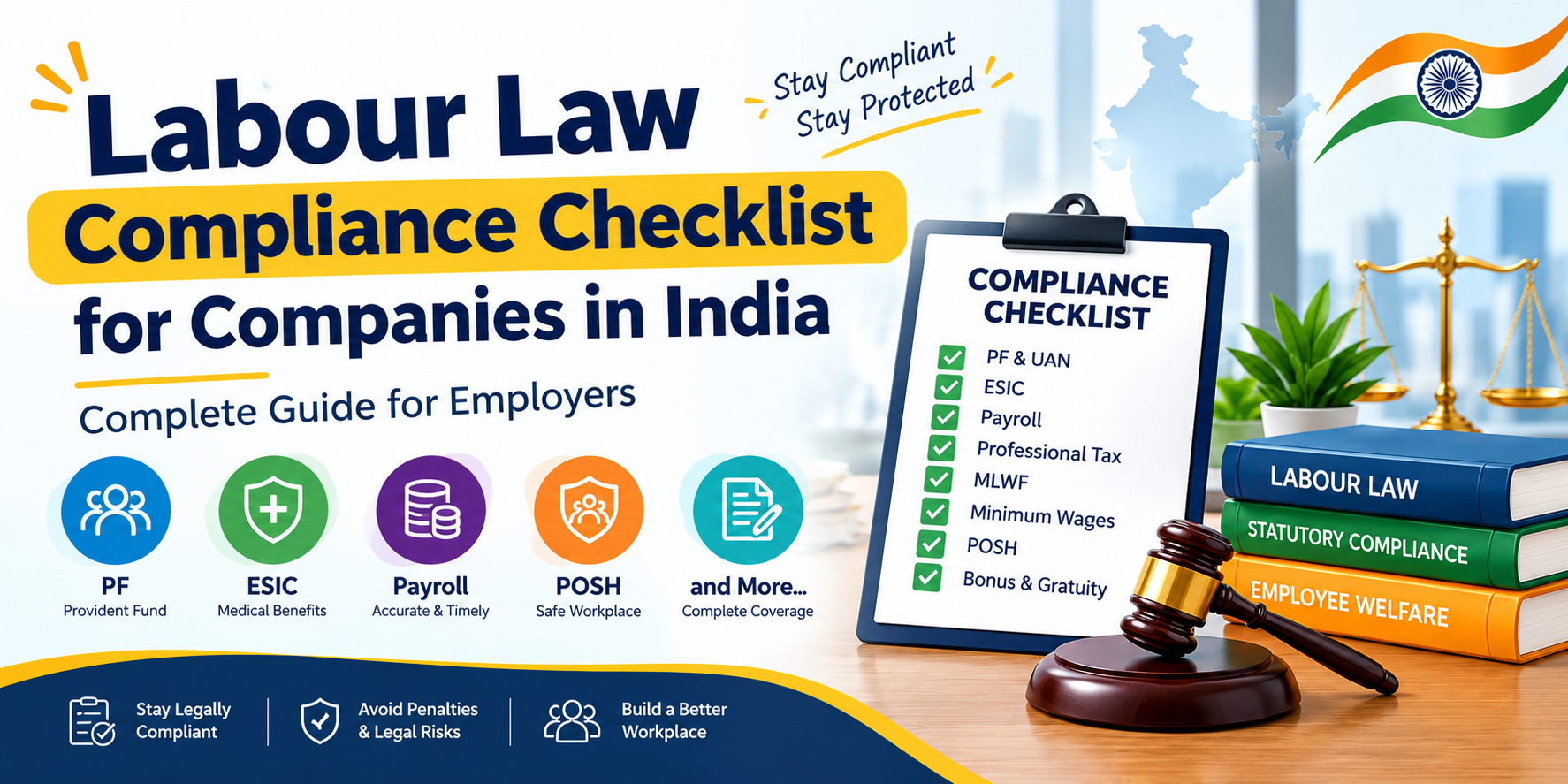

Running a business involves much more than managing employees and processing salaries. Every employer has a responsibility to comply with applicable labour laws, statutory registrations, employee welfare requirements and periodic compliance obligations.
For companies, startups and growing businesses, managing multiple compliance requirements can often be challenging. From Provident Fund (PF) and Employees' State Insurance (ESIC) to Payroll, Professional Tax, MLWF, Minimum Wages, POSH, Bonus and Gratuity, every area requires proper planning and timely action.
Failure to comply with applicable legal requirements may result in penalties, interest, notices, employee disputes and other legal complications. Therefore, businesses should establish a proper compliance system and regularly review their statutory obligations.
This article provides a practical Labour Law Compliance Checklist for Companies in India to help employers, HR professionals and business owners understand the major areas of HR and statutory compliance.
Labour law compliance plays an important role in the smooth functioning of an organisation. It helps businesses maintain proper employee records, ensure timely payments and provide statutory benefits to eligible employees.
A well-managed compliance system can help companies:
Labour compliance is particularly important for startups, MSMEs, manufacturing companies, IT companies, construction businesses and other growing organisations.
Provident Fund (PF) is an important social security benefit for eligible employees. Employers should review the applicability of PF requirements and ensure that required registrations, employee details and contributions are properly managed.
Eligible establishments should complete PF registration according to applicable requirements.
Employers should ensure that establishment information and employee details are maintained accurately.
Eligible employees should have a Universal Account Number (UAN).
The UAN helps employees manage their PF account and maintain continuity when changing employment.
Employee details and applicable KYC information should be maintained and updated.
This may include:
The Electronic Challan cum Return (ECR) should be prepared and filed according to applicable requirements.
Employers should verify employee details, wages and contribution amounts before submission.
PF contributions should be calculated correctly and deposited within applicable timelines.
Companies should regularly verify:
Employees' State Insurance (ESIC) provides social security and medical benefits to eligible employees.
Employers should review the applicability of ESIC based on their establishment and employee eligibility.
Eligible establishments should complete ESIC registration according to applicable requirements.
Proper establishment information should be maintained.
Eligible employees should be registered under ESIC.
Employee details should be entered accurately during the registration process.
Registered employees receive an Insurance Number, commonly referred to as an IP Number.
Employers should maintain proper records of employee IP Numbers.
Employee and employer contributions should be calculated accurately based on applicable requirements.
ESIC contributions should be deposited within applicable timelines.
Employers should maintain records related to:
Payroll is one of the most important functions of HR and statutory compliance.
A proper payroll process ensures that employees receive the correct salary while applicable statutory deductions and employer contributions are calculated accurately.
Companies should have a properly designed salary structure.
A salary structure may include:
Accurate attendance is important for salary processing.
Companies should maintain records related to:
Organisations should maintain clear leave policies and employee leave records.
Leave information should be properly considered during payroll processing where applicable.
Where applicable, overtime should be recorded and calculated according to applicable requirements.
Applicable deductions may include:
Employees should receive proper salary information and applicable deduction details.
A complete payroll process should include:
Professional Tax requirements may vary depending on applicable state laws.
Businesses should understand the Professional Tax requirements applicable in their state.
For businesses operating in Maharashtra, Professional Tax compliance may include applicable registration, deduction, payment and return requirements.
Professional Tax Enrolment Certificate (PTEC) requirements may apply to employers or professionals as applicable.
Professional Tax Registration Certificate (PTRC) requirements may apply to employers responsible for deducting Professional Tax from eligible employees.
Professional Tax should be calculated according to applicable state requirements.
Applicable Professional Tax should be deposited according to the prescribed schedule.
Applicable returns should be filed within prescribed timelines.
MLWF stands for Maharashtra Labour Welfare Fund.
The Maharashtra Labour Welfare Fund is intended to support the welfare of eligible workers. Employers should review the applicability of MLWF requirements to their establishment.
Applicable establishments should complete the required MLWF registration and maintain accurate establishment details.
Where applicable, employee contributions should be deducted correctly according to prescribed provisions.
Employers may also be required to contribute according to applicable provisions.
Employee and employer contributions should be calculated accurately based on applicable requirements.
MLWF contributions should be deposited according to applicable timelines and procedures.
Employers should maintain proper records of:
Every employer should ensure that employees receive wages according to applicable Minimum Wage requirements.
Minimum wage rates may vary based on several factors, including:
Employers should regularly monitor applicable government notifications and wage revisions.
Employers should ensure that applicable wage components meet the required standards.
Where applicable, revised allowances should be considered while calculating minimum wages.
Minimum wage rates may be revised periodically.
Companies should review payroll whenever new wage notifications become applicable.
After any wage revision, employers should check:
Creating a safe, respectful and inclusive workplace is an important responsibility for every organisation.
POSH compliance focuses on the prevention and redressal of sexual harassment at the workplace.
Companies should establish appropriate policies and mechanisms according to applicable requirements.
Organisations should maintain a clear policy related to the prevention of sexual harassment at the workplace.
Where applicable, companies should establish and maintain the required Internal Committee.
Employee awareness and sensitisation programmes can help create a better understanding of workplace behaviour and policies.
Employees should understand the process for raising a complaint.
The inquiry process should follow applicable procedures and principles of fairness.
Confidentiality should be maintained during the complaint and inquiry process.
Employers should review whether the applicable provisions relating to employee bonus apply to their organisation.
Review whether the establishment and eligible employees fall within applicable requirements.
Employee eligibility should be reviewed based on applicable provisions.
Accurate salary and wage records should be maintained.
Bonus should be calculated according to applicable requirements.
Proper records should be maintained for bonus payments.
Gratuity is an important employee benefit.
Employers should maintain proper employee records and review eligibility according to applicable provisions.
Companies should maintain accurate records related to:
Employee eligibility should be reviewed according to applicable laws and individual circumstances.
Applicable gratuity should be calculated accurately.
Eligible payments should be processed according to applicable requirements.
Companies engaging contractors and contract workers should carefully review applicable labour and compliance requirements.
Contract labour management requires proper coordination between the Principal Employer and Contractor.
Maintain accurate establishment and Principal Employer information.
Companies should verify contractor information and applicable registrations or licences.
Maintain proper records related to contract manpower.
Review applicable PF and ESIC compliance for eligible contract workers.
Maintain proper wage and payment records.
Review applicable workplace safety and employee welfare requirements.
PF Compliance
ESIC Compliance
Payroll Compliance
Professional Tax
Many businesses face compliance issues because of small but repeated mistakes.
Incomplete employee information can create problems during audits and compliance reviews.
Delayed statutory payments can lead to interest, penalties and other consequences.
An incorrectly designed salary structure may create difficulties in payroll and statutory calculations.
Employers should regularly monitor applicable wage notifications and revise payroll where required.
Incorrect employee details or salary calculations can affect statutory contributions.
POSH compliance should be treated as an important workplace responsibility.
Without a proper compliance calendar, businesses may miss important deadlines.
Managing multiple HR and statutory requirements can become difficult as a business grows.
The following practices can help:
Maintain a calendar for:
A compliance calendar can help HR teams track important due dates.
Keep updated records related to:
Regular payroll reviews can help identify:
Periodic HR and labour compliance audits can help organisations identify gaps and improve processes.
Professional HR and compliance support can be useful for:
Managing HR, Payroll and statutory compliance can be time-consuming for growing businesses.
Diligent HR – HR Management Services provides professional support to help organisations manage their HR and compliance requirements effectively.
Payroll Processing
Professional support for salary processing, payroll calculations, deductions and payroll management.
PF Compliance
Support for PF registration, employee-related processes and ongoing compliance requirements.
ESIC Compliance
Assistance with ESIC registration and compliance management.
Professional Tax and MLWF
Support for applicable PT and MLWF registration, contribution, payment and compliance requirements.
POSH Compliance
Support for POSH policies, Internal Committee requirements, awareness and compliance processes.
Contract Labour Compliance
Compliance support for contractors and Principal Employers.
HR Audit
Review of existing HR and statutory compliance processes.
Recruitment Services
Helping companies find suitable candidates for IT, Non-IT and other business requirements.
At Diligent HR – HR Management Services, we understand that compliance is not just about submitting returns or making payments.
Effective HR compliance requires:
Our objective is to help businesses focus on growth while managing their HR, Payroll and Labour Compliance requirements effectively.
Labour law compliance is an important part of running a responsible and successful business.
Depending on the nature and applicability of the organisation, employers may need to manage requirements related to:
A proper compliance checklist can help companies reduce risks, avoid missed deadlines, maintain accurate employee records and improve payroll and HR processes.
Businesses should regularly review the laws and requirements applicable to their establishment, industry and state because compliance requirements may vary and change over time.
Labour law compliance refers to following applicable employment, wage, social security, workplace and statutory requirements relevant to a business and its employees.
Depending on applicability, companies may need to manage PF, ESIC, Payroll, Professional Tax, MLWF, Minimum Wages, POSH, Bonus, Gratuity and other employment-related requirements.
Yes. Startups should review applicable labour and employment requirements based on factors such as employee strength, location, industry and business operations.
A compliance calendar helps companies track important payments, filings and compliance activities.
Yes. Diligent HR provides support for Payroll, PF, ESIC, PT, MLWF, POSH, Contract Labour Compliance, HR Audit and Recruitment Services.
Diligent HR – HR Management Services
We help businesses manage:
HR | Payroll | PF | ESIC | PT | MLWF | POSH | Labour Compliance | Recruitment
Focus on Your Business. Let Us Support Your HR and Compliance Requirements.