9604095112

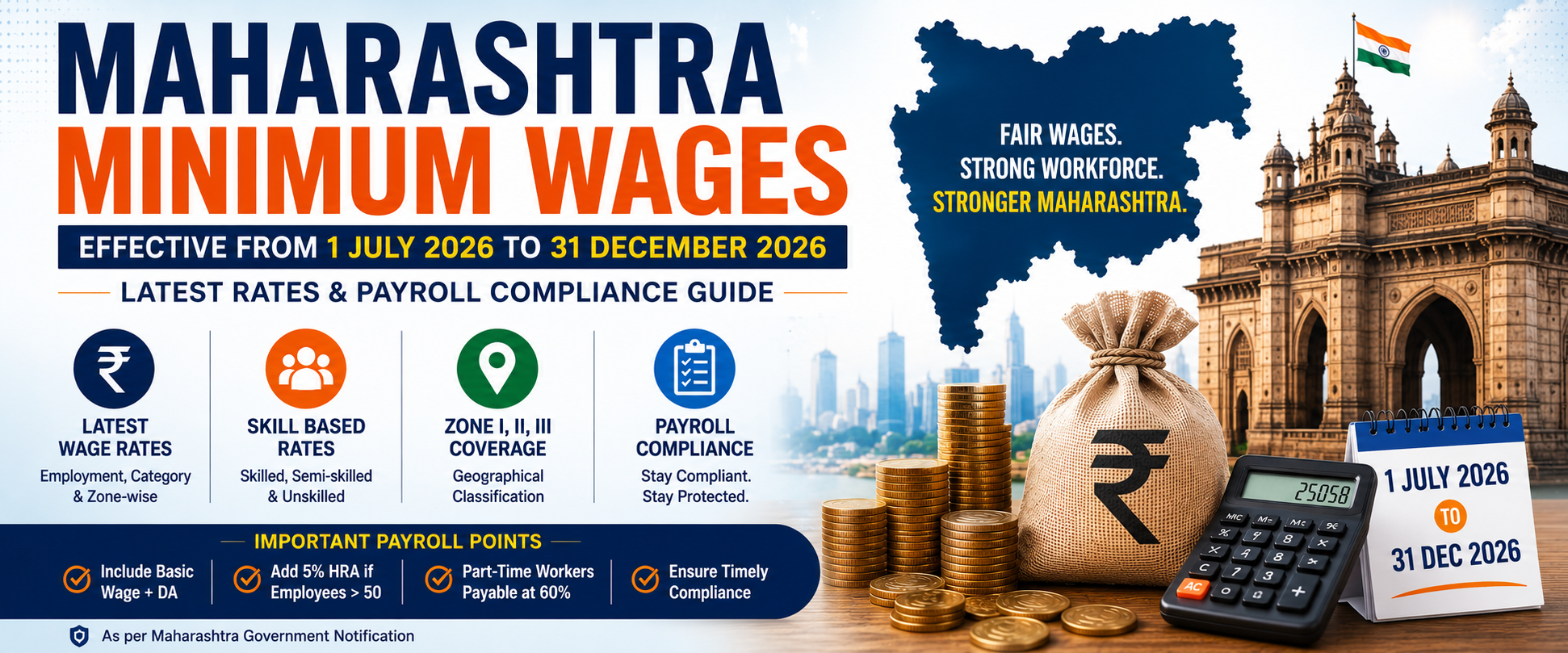

Maharashtra Minimum Wages Effective from 1 July 2026 to 31 December 2026
The Maharashtra minimum wage rates have been revised for various scheduled employments for the period from 1 July 2026 to 31 December 2026.
The applicable minimum wage depends on the type of employment, skill category and geographical zone. Employers should therefore identify the correct category before calculating employee wages and processing payroll.
Minimum wages are the legally prescribed minimum wages that employers must pay to workers covered under the applicable wage schedule.
In Maharashtra, the applicable minimum wage may vary based on:
Therefore, there is no single minimum wage applicable to all employees in Maharashtra.
The Maharashtra minimum wage schedule divides establishments into three geographical zones.
Zone I
Zone I includes Municipal Corporation areas, Cantonment areas and industrial areas within 20 kilometres of Municipal Corporation limits.
Zone II
Zone II includes areas within the limits of A and B Grade Municipal Councils.
Zone III
Zone III includes other areas of Maharashtra that are not covered under Zone I or Zone II.
The applicable wage can therefore be different for employees performing similar work in different locations.
The wage structure generally consists of:
Basic Wage + DA or Special Allowance = Total Wage
For example, for Construction of Roads and Buildings, the total monthly wage for Zone I is:
Skilled Worker: Rs. 25,058
Semi-Skilled Worker: Rs. 23,543
Unskilled Worker: Rs. 22,463
The DA or Special Allowance applicable to this employment is Rs. 3,198 per month.
For Hotels and Restaurants, the DA or Special Allowance is Rs. 8,176 per month.
The total monthly wage is:
Skilled Worker
Zone I: Rs. 15,876
Zone II: Rs. 15,576
Zone III: Rs. 15,376
Semi-Skilled Worker
Zone I: Rs. 15,176
Zone II: Rs. 14,876
Zone III: Rs. 14,676
Unskilled Worker
Zone I: Rs. 14,676
Zone II: Rs. 14,376
Zone III: Rs. 14,176
For Shops and Commercial Establishments, the DA or Special Allowance is Rs. 4,134 per month.
Skilled Worker
Zone I: Rs. 15,766
Zone II: Rs. 15,170
Zone III: Rs. 14,574
Semi-Skilled Worker
Zone I: Rs. 14,990
Zone II: Rs. 14,394
Zone III: Rs. 13,798
Unskilled Worker
Zone I: Rs. 14,155
Zone II: Rs. 13,559
Zone III: Rs. 12,962
HR and payroll teams should carefully review the following points before processing wages.
First, identify the scheduled employment applicable to your organisation. Different industries have different minimum wage rates.
Employees should be correctly classified as skilled, semi-skilled, unskilled or another applicable category.
Confirm whether the establishment falls under Zone I, Zone II or Zone III.
Make sure the applicable Basic Wage is correctly configured in the payroll system.
The applicable DA or Special Allowance should be added according to the relevant scheduled employment.
Employers should ensure that the revised rates are considered from the effective date of 1 July 2026.
The wage schedule provides that where the employee count is more than 50, an additional 5 percent HRA is to be added on Basic Wage plus Special Allowance.
Employers should review their payroll structure and apply this requirement where applicable.
For part-time workers, the schedule provides payment at 60 percent of Basic Wage plus DA.
Employers should first identify the applicable employment and then apply the relevant calculation.
Minimum wage compliance is an important part of payroll and labour law compliance.
Incorrect wage calculations can lead to:
Regularly reviewing minimum wage rates can help employers maintain accurate payroll and reduce compliance risks.
Before processing payroll, employers should check:
The Maharashtra Minimum Wage schedule applicable from 1 July 2026 to 31 December 2026 provides different wage rates based on employment type, skill category and geographical zone.
Employers should not use one common minimum wage figure for all employees. The correct rate should be determined by checking the applicable employment, worker category, zone, Basic Wage and DA or Special Allowance.
A regular review of minimum wage rates can help organisations maintain accurate payroll and strengthen labour law compliance.
Stay compliant. Stay updated. Stay ahead with DiligentHR.
This article is based on the Maharashtra Minimum Wage schedule applicable from 1 July 2026 to 31 December 2026 and is intended for general informational purposes only. The applicable wage may depend on the scheduled employment, worker category, geographical zone and other conditions specified in the applicable notification. Employers should refer to the applicable government notification before making payroll or compliance decisions.
Download Attachment
DA-July-2026-to-Dec-2026-english-Manual_(1)1.pdf